Why can not the same plastic mold be used for multiple different plastic materials
Why can't the same plastic mold be used for multiple different plastic materials?
1. Molding Temperature Mismatch
PET: Requires very high processing temperatures (typically above 260°C) to reach the ideal molten state for injection molding and stretching.
PP: Requires much lower processing temperatures (typically around 200°C).
Consequences: If PP material is injected into a high-temperature mold designed for PET, the PP will rapidly degrade due to the excessive temperature,
causing molecular chain breakage, resulting in brittle, discolored (yellowing), and even the production of toxic substances. Simultaneously, excessively
high temperatures can damage the mold's surface treatment layer.
2. Different Shrinkage Rates (The Most Critical Reason)
This is the direct cause of dimensional inconsistencies.
PET: Shrinks relatively little and uniformly when cooling from the molten state.
PP: Shrinks much more than PET, and the difference in shrinkage rates between the flow direction and the vertical direction is significant (anisotropy).
Consequences: PET mold cavity dimensions are designed for the low shrinkage rate of PET. If used to produce PP, PP will shrink even more after cooling,
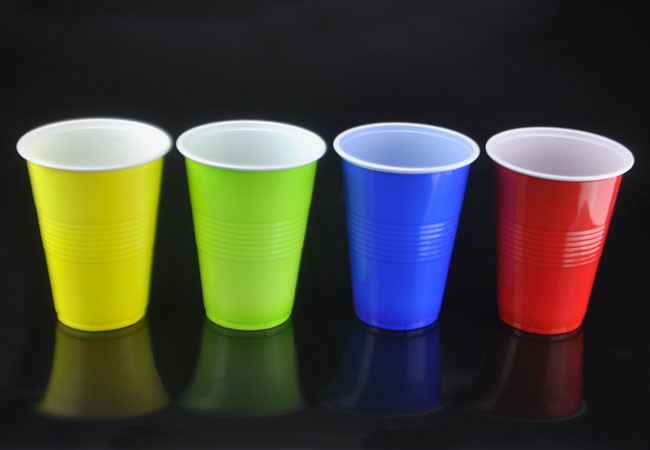
resulting in: Cups that are severely undersized and unusable. The cup walls are twisted, warped, and deformed.
The cup rim is not round, and the lid cannot be closed tightly.

3. Fundamental Differences in Molding Processes
This is the most fundamental incompatibility at the equipment level.
PET cup molds: Designed for injection stretch blow molding machines. The process involves: first, injection molding a preform; then transferring the
hot preform to the blow molding station, stretching it longitudinally with a stretching rod, then blowing in high-pressure air for transverse stretching,
ultimately forming the shape through bidirectional stretching.
PP cup molds: Typically designed for injection molding machines. The process involves: directly injecting molten PP into a cup-shaped cavity, cooling,
and then ejecting it. Some PP cups are also made using injection stretch blow molding, but the process parameters are completely different from PET.
Consequences: Equipment incompatibility: PET molds cannot be installed on ordinary injection molding machines, and vice versa.
Functional Defects: Even if PET molds are forcibly used to produce PP on an injection stretch blow molding machine, the stretching rods may not function
effectively due to the different crystallization characteristics and tensile properties of PP compared to PET. This can lead to uneven cup wall thickness and
insufficient strength.
4. Differences in Mold Design Details
Cooling System: Due to the different crystallization temperatures and cooling rates of PET and PP, the cooling channel design of the mold needs optimization.
An incorrect cooling system can cause uneven cooling of the PP cup, generating internal stress and causing deformation.
Ejection System: PP has a high shrinkage rate, requiring different draft angles and ejector pin arrangements compared to PET. Using PET molds may result in
difficulty demolding the PP cup, or even breakage.
Runners and Gates: The two materials have different flowability (melt index). The runner dimensions and gate design of PET molds may not be suitable for PP,
leading to incomplete filling or defects such as jetting marks.
Summary: You can understand it this way: PET and PP are like wheat flour and glutinous rice flour. Although both are "flour," their properties are completely different.
Using the molds and methods for making noodles to make glutinous rice balls will inevitably result in failure.
Therefore, "specialized materials and molds" are essential in production. To produce cups made of PP material, molds specifically designed and optimized for PP must
be used, and production must be carried out on appropriate molding equipment.